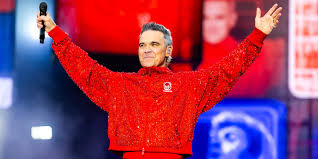
The Beatles’ record for most U.K. No. 1 albums was broken by Robbie Williams on (date). Outside of the U.S., Robbie Williams has spent the last three decades as one of the most successful live and studio artists. He has sold over 75 million records, dominated European charts and has played for some of the biggest concert crowds in pop history. Williams’ ascent to the top of stardom did not come out of nowhere; fame came at a serious cost and intense risks that paid off.
“Take That” was a british boyband modeled after “New Kids On The Block,” composed of Gary Barlow, Mark Owen, Jason Orange, Howard Donald and Robbie Williams. The band reached pop stardom throughout Europe with their hit single “Back For Good” which reached the top 5 in over 10 countries, peaking at No. 7 in the U.S. The group seemed on track to become giants in pop, but behind the scenes, there was turmoil within the group. Williams had much bigger ambitions and felt out of place and undervalued in the group. Looking for more creative control like leader Barlow, Williams announced his exit from the group on July 17, 1995, with the band splitting not long after in February 1996.
Now solo, Williams began a writing collaboration with songwriter Guy Chambers, a move that would later make them the most successful British songwriting partnership since Paul McCartney and John Lennon. By early 1997, the pressure mounted due to poor press and slow sales. Industry doubt pushed him close to being dropped, forcing Williams and Chambers to double down on material that reflected his vulnerability and ambition. The gamble paid off when the single “Angels’’ transformed his public image and drove his debut album “Life Thru A Lens” into a long-running chart success, moving him in a matter of months from label uncertainty to the dominant new force in British pop.
Following the success of “Life Thru A Lens” Williams capitalized by releasing “I’ve Been Expecting You” in late 1998 with hits like “She’s The One,” “Millenium” and “No Regrets.” The album cemented Robbie as the most popular British artist at the time. With Europe conquered, Williams set his sights on the one place he had not tapped into, the U.S.
On May 14, the album “The Ego Has Landed,” a compilation of the last two albums, was released through Capitol Records in the U.S. Although it sold relatively well at around 500,000 copies, Williams was at a point of intersection: either pursue U.S. success or continue on the road he had been on as the biggest pop artist in Europe. Williams chose the latter, citing problems with addiction and stardom. He later recalled that when he had arrived in America to promote the album, he was “mentally ill…an addict and an alcoholic,” overwhelmed by a level of success he “couldn’t manage.” At the point where a U.S. breakthrough would have made him globally dominant, he began to question the ambition itself.
“I’ve got money and I’ve sold albums… Why do I want that? Why do I need that? And I was like, well, I don’t.” Williams said during a BBC Radio 2 interview.
Not far after Williams fully embraced his now larger than life persona with the album “Sing While Your Winning” in 2000, with songs like “Rock DJ” which fully leaned into Williams’ more cheeky personality. This album started what is known as Williams’ early 2000’s “imperial” phase.
From 2000-2005, Williams had five #1 albums and countless #1 singles. In 2003, on the last stop of his “Weekends of Mass Distractions” tour, Williams played three sold-out shows to a total crowd of 375,000 people, the highest attendance for a concert in the UK. At the Peak of his powers, Williams decided to once again search for something new. As disagreements with Chambers grew, Williams decided to end his partnership with him. A move that surprised many since they had together sold over 40 million records.
“Intensive care” was released in October of 2005. Williams described it as his first “true solo album,” and the subsequent “Close Encounters tour” was Williams’ biggest to date. The record-breaking tour spanned Africa, Asia, Europe, the Americas and Australia, selling 1.6 million tickets in one day and entertaining over three million people in total. But during the tour, Williams released the album “Rudebox,” which delivered Williams his first “flop” in years. With poor new album sales, and on a monumental stadium tour, the troubles and stress caught up to him, and he canceled the final leg of his “Close Encounters tour” due to severe exhaustion, stress and health concerns. Following intense, back-to-back performances in Europe and South America, it was deemed that continuing with the Asia dates would seriously impact his health.
So, what does mega fame do to a person? In Williams’ case, depression, paranoia and a severe drug addiction. After the cancellation of his tour, Williams took a step back from music and admitted he “silently retired” in 2006 following a mental breakdown after his tour. He kept this decision private.
2009 marked a comeback for Williams. With his album “Reality Killed The Video Star” Giving Williams Another #1 album. Not only a solo comeback but a group comeback, Williams rejoined Take That for the first time since his departure in 1995. The group released “Progress” in 2010 and toured in 2011 and 2012.
William’s has long cemented himself as a legend and icon in pop, stadium tours. Millions of albums and ticket sales and even biopics. His latest album “BRITPOP” gave Williams his 16th UK No. 1 album, breaking the previous record held by The Beatles.
Needless to say, U.S. chart success does not dictate overall success. As many artists like Williams have had immeasurable successful careers outside of the U.S., with “BRITPOP” reaching No. 8 on the US iTunes chart, it is not too late for Americans to finally come around to Robbie Williams.