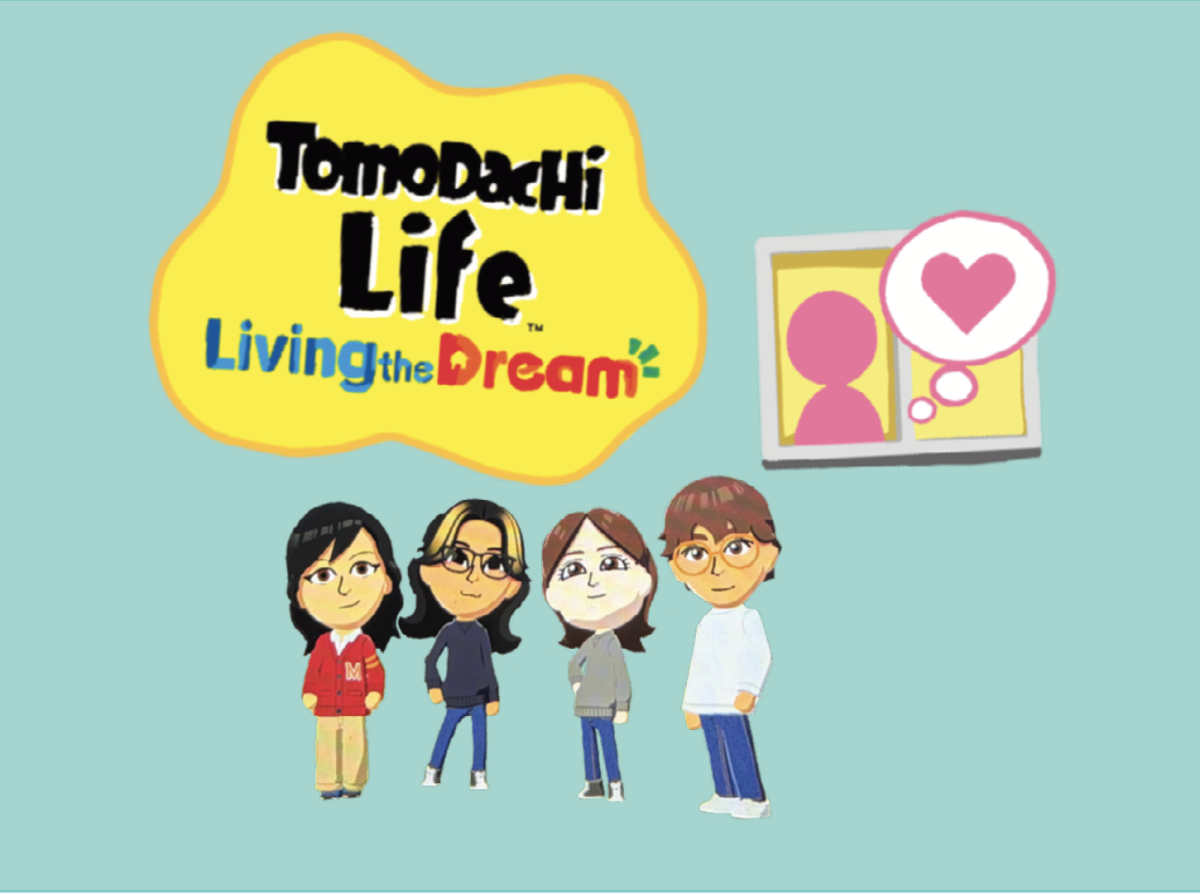
On March 25, 2026, Nintendo released the demo for Tomodachi Life: Living the Dream, about 12 years after the release of the original Tomodachi Life game. While the demo allowed up to three characters, the progression of the game was limited, leaving players to wait until its official release on April 16, 2026.
The original Tomodachi Life (2014) for the Nintendo 3DS offered a charming life-simulation game where the player can create an assortment of Mii characters to live on an island. The player had the ability to form relationships, and have the Miis behave unpredictably. Individuals who played the original
Tomodachi Life enjoyed the creation of characters and the variety of minigames that came with the game. The game was intended to draw similarities to Tamagotchi, a children’s toy requiring one to take care of the creature, with various customizations and a slow paced setting. Popularity of the game increased due to social media and Youtube.
“I saw a lot about it online growing up, like playthroughs on YouTube in elementary school,” FHS junior Hazel Neustaetter said. “I also had a friend who had the original game.”
The first few years after the release of the first game, there was very little demand for releasing a sequel to the game. Another game similar to Tomodachi Life was released, which was titled Miitopia, which filled the gap of individuals who did want a sequel. A large community praised and missed the bizarre, chaotic and hilarious simulation that Tomodachi Life presented.
Nintendo, the gaming company, then aired a Nintendo Direct on Jan. 29, 2026, which surprised many. This Nintendo Direct released information on the works of Tomodachi Life: Living the Dream, which highlighted similar features from the original game, but with much more for the players to anticipate. This information re-ignited popularity for the game, and with more features available, made Tomodachi Life suitable for anyone.
When Tomodachi Life: Living the Dream came out, players were introduced to a revamped Mii Maker, deeper relationships customization and decorative island features. In comparison to the original game, Tomodachi Life: Living the Dream had more diversity and an expansion of creative freedom and many more of those bizarre cutscenes.
Tomodachi Life: Living the Dream is also not the type of game that one would constantly spend hours grinding and playing on, making it an idle game that allows one to play conveniently. Its flexibility allows users to log on, play and log off.
“I spend maybe 30 minutes on the game,” Neustaetter said. “The game itself isn’t really intended for long form playing. It’s not like those games where there’s constantly stuff happening, it’s more like the sort of thing you check in on.”
This new release sparked lots of talk on social media, boosting its already found popularity and allowing others to discover the game. However, there is lots of controversy surrounding the game itself, such as emulation. Emulation allows others who do not own a Nintendo or the game to play it on a separate device such as their laptop or phone. The topic of emulation sparked controversy among certain people, with some justifying it due to the game being priced at $60, as well as the Nintendo switch costing about $200. Others are defending Nintendo because of some problems with emulation regarding various glitches and crashes when playing.
“Overall, the game is pretty fun because I like creating characters and seeing how they interact,” Neustaetter said. “So I think that it is worth it to get the game.”