For the last few years, simply mentioning the phrase Artificial Intelligence would send a company’s valuation through the roof. Naturally, every major corporation dumped billions of dollars into building larger data centers and releasing newer models of their applications. It seemed like a good idea for the general masses too. At first, students could write essays in seconds, workers could get more done and everyday life was easier to get through. Looking beyond the rose tinted glasses, the problems became apparent: water shortages, skyrocketing energy costs and worst of all for gamers, a shortage in random access memory cards, called RAM.
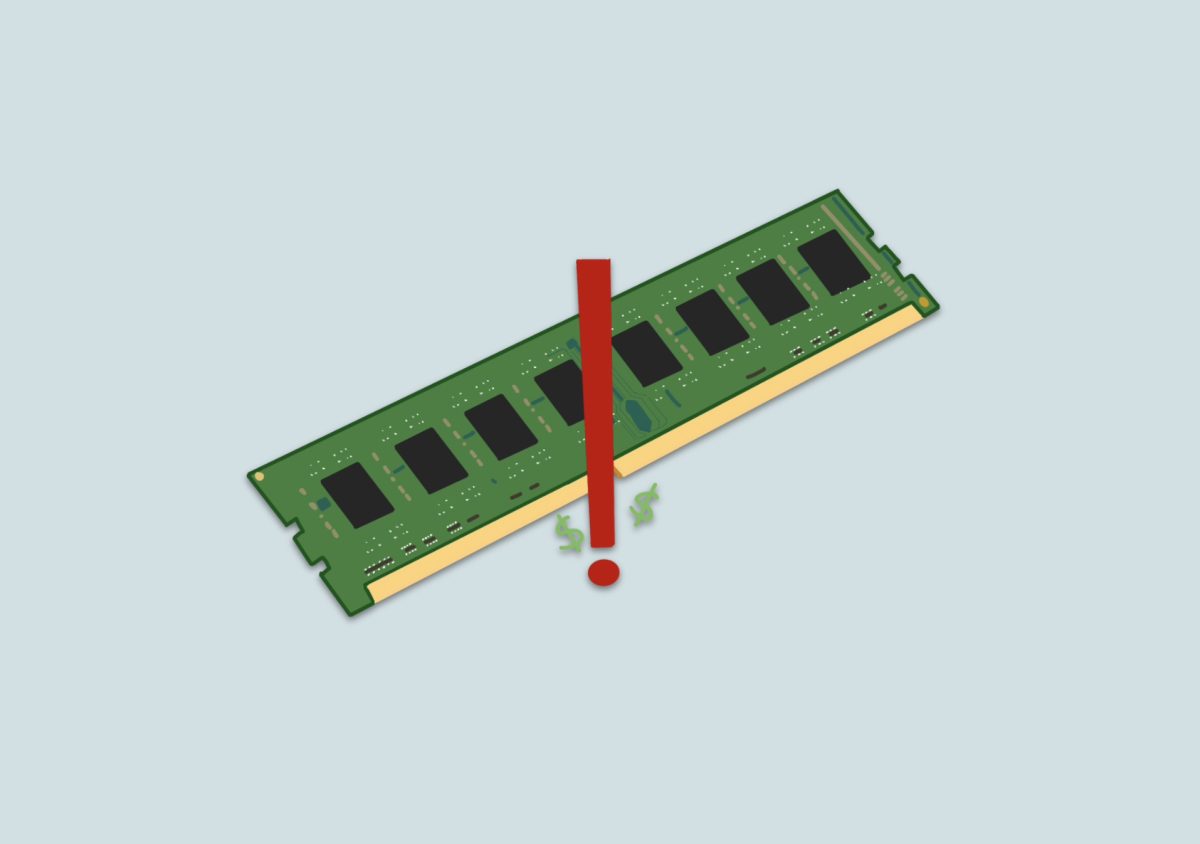
Building a custom PC is a complex process. It requires weeks of planning, hours of YouTube tutorials, a spreadsheet with too many different configurations, all for a PC that one probably does not need. RAM used to be the easy part, reasonably priced, easy to install, never causing any problems. Then the AI boom hit, and suddenly one of the most boring parts of a PC build became the most painful to purchase, with 64 gigabytes of RAM costing upwards of $700. For FHS junior Vidyuth Pasumarthi, this spike in RAM prices could not have come at a worse time.
“My machine learning tasks take up a lot of storage on my computer,” Pasumarthi said. “My original plan for my budget was around $1500 to $2000 which is [the] average price to get a good GPU [Graphics Processing Unit] to get a good amount of storage and RAM.”
A year ago, this would have been a reasonable budget, perhaps a little excessive. However, that same build today would cost significantly more.
“It would cost probably an additional $1,000 or maybe even more, or if I’m looking for a high-end PC, which is really an insane price that I would not be willing to spend,” Pasumathi said.
FHS engineering and math teacher Bob Capriles acknowledged the severity of the problem. “I know that the demand has gone up tremendously for RAM and other semiconductor devices,” Capriles said.
To understand why, it is important to understand what RAM actually does. RAM is your computer’s short term memory. It holds whatever a computer is actively working on. The more work a computer has, the more that RAM can process. For gamers, that means more frames and faster loading speeds.
For AI data centers, RAM serves a different purpose entirely. Running a single Large Language Model (LLM) requires terabytes of memory simultaneously. Multiplying this by every chatbot, image generator and “productivity tool,” it becomes easy to see why RAM is in high demand and short supply.
Some experts might say that AI grade memory and RAM are technically different markets, and that data center requirements do not directly affect what you pay at checkout. While this is technically correct, the problem is not the supply chain but is less complex. When manufacturers start prioritizing high margin AI memory contracts, consumer chip production is reducd [sic].
For the next few years, the price of RAM is only expected to rise, with consumers having the short end of the stick. Micron, one of the world’s largest microchip and RAM manufacturers, has already made the decision to abandon the consumer memory market entirely, while the fastest kind of memory, DDR5, has started to cost more than a PlayStation 5.
For now, the options are grim: wait it out, overpay or take up a cheaper hobby. Just remember to not ask AI for advice on what to do, that is probably going to increase the price of RAM further.