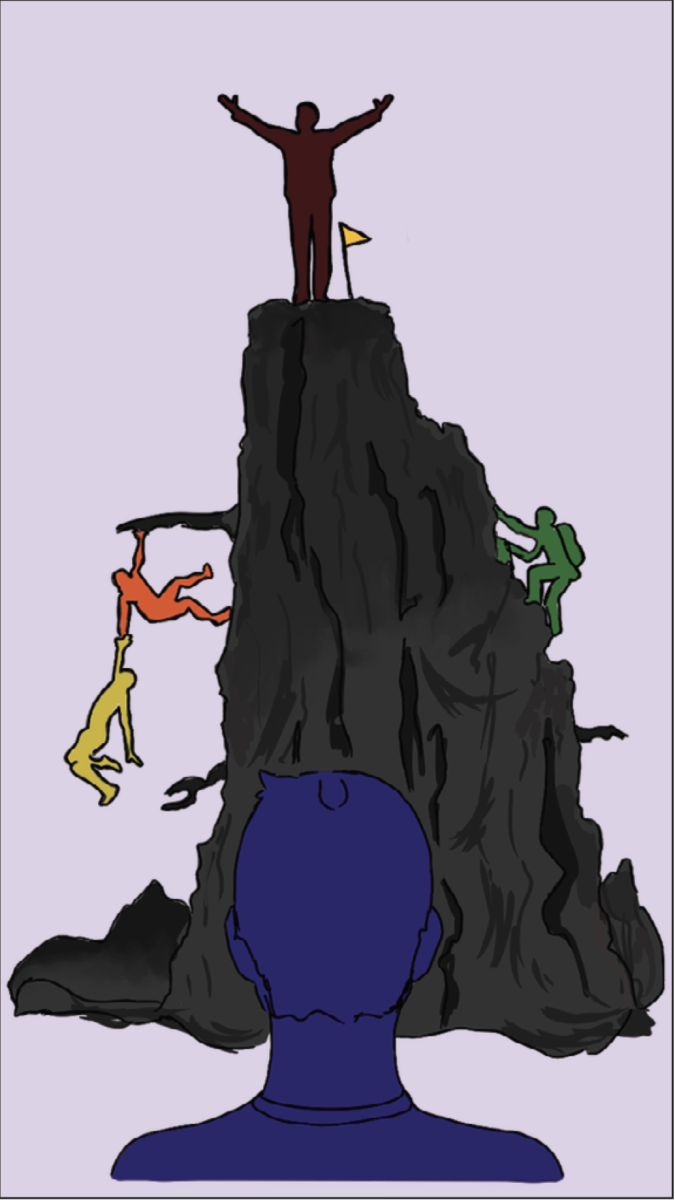
I am not a naturally gifted musician at all. In fact, I am pretty hopeless — I had to teach myself how to breathe while multitasking so I stop suffocating — and I am still unprepared to be a cello major in college. No matter how hard I practice, I will never play at a world class level.
Yet, I am an accomplished cellist. I have won competitions, played for California’s All-State Orchestra and I am even going to a top tier music school next year. Despite not being able to coordinate my arms and relax my body, I achieved many great things, allowing my track record to reflect significant musical prowess.
And this is where the idea of “talent” comes into play. People who may know me, but do not actually know me, tend to say that my accomplishments are all because of talent and overlook the idea of a decade of hard work.
This does not just apply to me, or even to music. In fact, we polled the students in our publication, and over 70% affirmed their belief that “talent” and “effortless greatness” are overused excuses which fail to account for hard work and persistence.
In his book “Outliers”, Malcolm Gladwell popularized the “10,000-hour rule,” which suggests that achieving mastery in any field requires roughly 10,000 hours of deliberate practice. Through this, Malcolm suggests that many successful figures, such as Dodgers pitcher Shohei Ohtani, electronic duo Daft Punk and renegade street artist Banksy, only attained such a high level of proficiency after countless hours of experience with their disciplines.
However, just “showing up” for 10,000 hours does not guarantee mastery either. To climb up to that pedestal, one must put 20 hours of work in every week for ten years, which is the equivalent of four hours every weekday. Even in those four hours, psychologist K. Anders Ericsson suggested that each minute should be spent working purposefully with a goal in mind.
In an article with Harvard Business Review, Ericsson used golf as an example. After practicing for a number of hours, anybody can be proficient enough to play a round with friends. However, the top-tier professional golfers do not stop there, and continue to polish their game. They will focus on improving the weakest parts of their technique, and absorb as much feedback from coaches and teammates as possible.
Over the past ten years, I have probably played over 15 million notes on the cello and that has helped me improve a lot. I still have so much to improve — from controlling bow pressure, to finding the most efficient posture — yet I have also learned how to listen to other musicians, focusing on their nuances and little ornamentations that make the music sparkle.
Most people still have the wrong understanding of the word “talent” and its meaning. People often use the word “talented” when they actually mean that someone is extremely skilled at their practice — a misuse that makes the subject feel insulted. Calling somebody talented diminishes their development; it assumes that since one makes something appear easy to do, they did not work hard to get to that level and instead were born already understanding how to do it.
But here is what I wrongly conflated in my anger at being called “talented”: the word “talent” is used often in two different ways, and I was only mad at one of them.
The first kind of talent — the myth I was angry about — is the idea that some people are born with a “magic shortcut” that makes all the hard work unnecessary. It is an excuse that people can hide behind when they have not put in enough effort.
The second kind of talent, the one I do have, is real. This talent is innate. It is more like a head start in a marathon — or a steeper learning curve in the beginning. Some people are born with longer fingers that naturally fit the cello better. Other people are genetically gifted with denser muscle fibers or a more optimized body composition. And then others have brains that understand information more quickly and innately remember better.
When I was in elementary school, I had poor technique. However, I could hear when I was out of tune, and that bothered me enough to fix it. That is a talent. My friend practiced just as much as me but could not hear the difference for years. We both worked hard, but I got further.
Talent helps determine someone’s ceiling and overall potential for growth. Putting the right kind of work into practicing is what determines if they reach that ceiling or not.
Someone could practice basketball for 10,000 hours with the dream of becoming a professional basketball player, but if they are 5’6” with slow reflexes, they will not make the NBA. Someone might spend hours and hours practicing painting, but without an innate sense of spatial reasoning, they will plateau long before reaching mastery.
Although it is not fair, that is reality. The real problem is not that people acknowledge talent where it is due. It is that they hide behind “talent” as a cliché to justify their lack of effort. They see the result, credit it to talent and stop thinking. They forget to consider what worked, what failed, what the other person sacrificed to reach that level of success and what they are still struggling to overcome.
When someone calls me talented and walks away, they are not insulting my work ethic. They are just being lazy. They would much rather believe I was born holding a cello bow in my right hand. The 70% of writers for The Phoenix that we polled who said ‘talent’ is an overused excuse understand this. They have seen people dismiss effort by crediting talent instead.
So here is the final takeaway: stop saying “you are so talented” as if that explains everything. Instead, tell people, “you have clearly put in serious effort,” or “you are incredibly skilled.” Do not hide or shy away from the truth, but acknowledge both the advantage and the effort.
Because talent only opens the door. Deliberate practice and focused effort are what build the house. But some doors lead to bigger rooms than others and no amount of practice can change that. The question is not about fairness. The question is: what will you build with what you have?