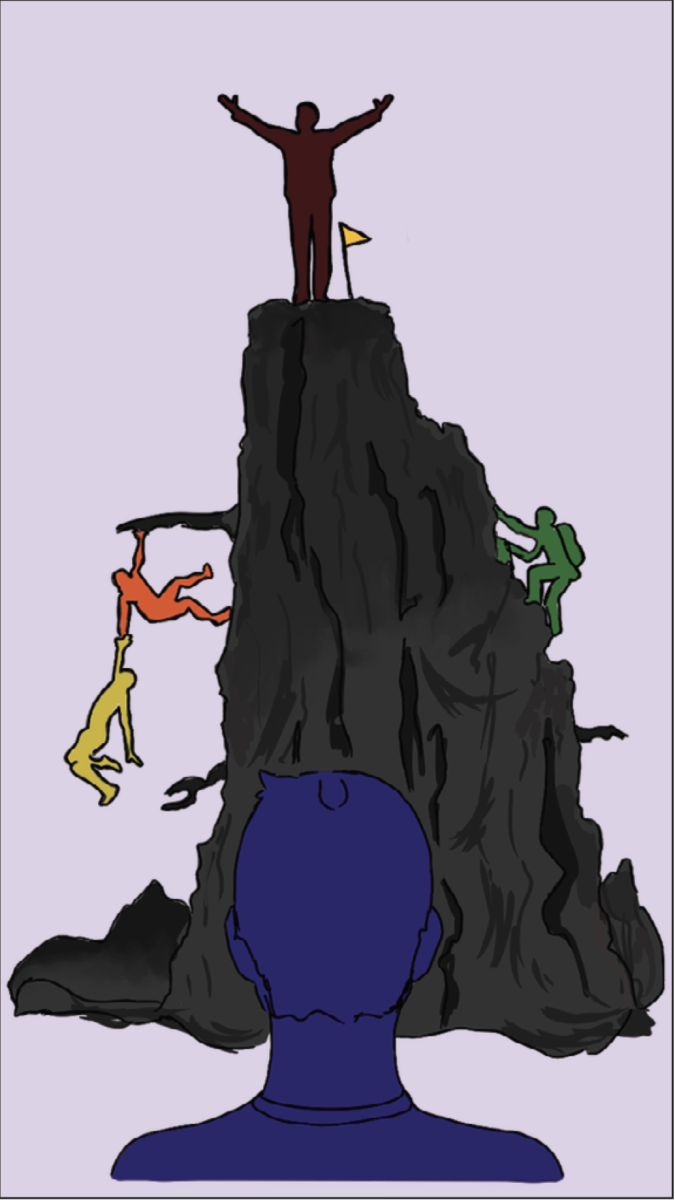
“More than half of suicide decedents in the United States have been described by loved ones as perfectionistic,” according to a study conducted by Crux Psychology. This statistic serves as a chilling reminder that what many believe to be a strength is truly a harmful force that damages mental health and erodes one’s well-being. Perfection is marketed as the ideal, the norm — the star student, the strong athlete, the formidable leader — we celebrate unblemished lives, as if that is something humans are meant to achieve. But behind the facade of perfection lies intense, unspoken pressure.
Society treats perfection as a badge of honor. It is convenient and easy to admire the results: good grades, recognition and money. What society fails to consider are the consequences — and frankly, the harsh reality. Perfection cannot be executed simply through skill; it asks for a rejection of mistakes, a personal invalidation. Ironically enough, the opposite message is repeated constantly: “Mistakes are proof you are trying.” This is a narrative we see again and again: mistakes correspond to learning, which corresponds to growth.
So, if this concept is promoted, why is it that the spiral of perfectionism makes its dent in every student, every athlete and every profession? Perfectionism defines worth by outcomes instead of growth, and that is the recurring conflict causing one’s underperformance, struggles with change, and in severe cases, suicide. On March 1, 2022, Katie Meyer, the standout goalkeeper for Stanford University, was discovered unresponsive in her campus dormitory; she had committed suicide not long before she was found. Her parents, who stated there were no signs that she was having mental health issues, later found a disciplinary letter from the university in her dorm room.
The misconduct given to Meyer was that she spilled coffee on a fellow student who had allegedly assaulted one of her younger teammates. This letter of misconduct was reportedly her breaking point; the pressures of being a standout goalie as well as a strong female role model for her younger teammates resulted in a cosmic injustice that Meyer did not deserve. The constant demand to be “perfect” in both skill and character left Meyer with little room to make mistakes.
A letter of misconduct is simply a warning to put students on a path towards improvement. In Meyer’s case, this would mean managing her anger and her emotions. Her nature of perfectionism kept her from that improvement. The pressures of perfectionism are subtle, but significant. They disguise themselves as ambition or responsibility, but they leave no space for humanity.
Perfectionism, in this way, becomes a trap. It teaches people that mistakes are intolerable, that failure equals shame, and that any weakness can undo all accomplishments. Meyer’s story illustrates the consequences of this mindset: the weight of unrealistic expectations can push even strong, capable individuals to a breaking point.
We celebrate flawless performance and an omnipresent sense of composure, yet we rarely recognize the internal struggle it takes to maintain it. True strength is not being perfect. It is being resilient, learning from mistakes and continuing to grow despite them. Meyer’s story reminds us that perfectionism is not a virtue, but a trap that can lead to unnecessary suffering and injustice. By expecting constant perfection, we risk overlooking the humanity that makes people not just capable, but extraordinary.